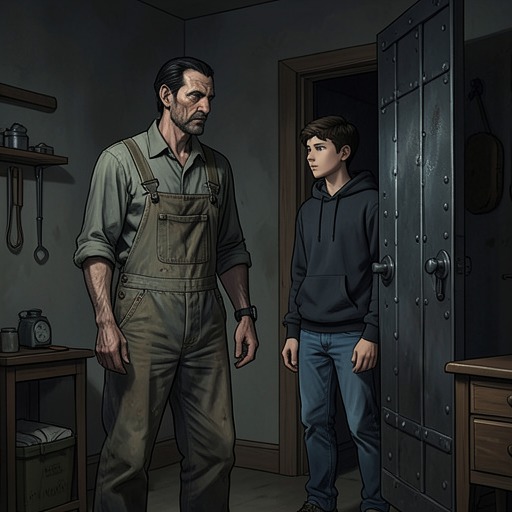
Mirsad and Amel’s father-son relationship
A Man Called OveMirsad and Amel’s father-son relationship moves from rejection to a cautious, practical reconciliation. Its turning point is Mirsad’s decision to tell his father that he is gay: Amel’s longstanding hostility makes the disclosure dangerous to their bond, and Mirsad ends up away from his family home. Their later reunion begins not with an apology or a speech, but with Amel waiting outside Ove’s house for his son to return.
Identity and Rupture
Mirsad tells Ove that he informed his father he was gay. He explains that Amel had expressed hatred toward gay people and had said he could not accept having a gay child. When Mirsad came out, Amel did not take the news well. The disclosure therefore exposes a conflict that is both personal and rooted in the father’s stated beliefs: Mirsad names an essential part of himself, while Amel’s response drives a separation between them.
The consequences are immediate. Mirsad is thrown out and Ove takes him in. When Ove later faces Amel at the café, the scene makes the contrast between the two older men plain: Ove has been unable to turn Mirsad away, whereas Amel did. The estrangement is not described through a long account of arguments. Instead, the story gives its decisive outline through Mirsad’s account of coming out, his displacement, and the fact that he is living under Ove’s roof.
The Return to Ove’s House
Amel’s reappearance begins with waiting. After Mirsad, Ove, and the cat return to their street, they find the stocky man outside Ove’s house. He has apparently been there for much of the morning, standing with the fixed posture of a sentry in the freezing weather. When he sees Mirsad, he comes to life, shifts his weight, and greets him. Mirsad answers by calling him Dad.
The exchange is small but consequential. Neither man is reported making a full apology or explaining what will happen next. Still, Amel has come to meet his son, and Mirsad responds rather than avoiding him. The narrative lets their brief greeting carry the uncertainty of the reunion: their relationship has not been repaired by a single conversation, but contact has become possible again.
Ove’s home provides the setting for what follows. That evening, while Ove eats with Parvaneh and Patrick, father and son talk in the kitchen. Their conversation moves through disappointment, hope, and masculinity, in two languages, and comes especially to concern courage. The account does not specify every detail they exchange. Its emphasis is on their willingness to remain in the conversation after the painful disclosure that divided them. Ove thinks Sonja would have liked this development and tries not to let his pleasure show too much.
Reconciliation Through Shared Milestones
The later wedding of Mirsad and Jimmy marks a further change in Amel’s relationship with his son. Mirsad is visibly nervous before going into the Town Hall, and Parvaneh gives him tequila to steady him. Ove serves as best man. The celebration takes place at Amel’s Café, placing the family occasion in Amel’s own workplace rather than keeping the two men apart.
Amel tries three times to make a speech, but emotion leaves him able to manage only a few halting words. The scene presents his feeling through difficulty speaking, not through a polished account of remorse. He also names a sandwich after Jimmy; Jimmy regards this as a magnificent present. These gestures do not erase the earlier rejection, but they show Amel taking part in his son’s marriage and finding a way to welcome Jimmy into the family occasion.
The family’s story continues beyond the wedding. The following year, Mirsad and Jimmy adopt a little girl. Jimmy brings her to Anita and Rune’s house every afternoon for coffee. The account does not describe every later interaction between Amel and Mirsad, so their everyday relationship should not be assumed from this detail alone. What it does establish is a changed family landscape in which Mirsad has married, become a parent, and taken part in a wedding attended by a father who once rejected him.
Narrative Significance
The relationship develops through distinct acts of acceptance and return: Mirsad tells the truth about himself, Amel’s rejection separates them, Ove offers Mirsad a place to stay, and Amel eventually waits for his son and joins in his wedding. The story gives particular weight to ordinary actions—a greeting outside a house, a conversation around a kitchen table, an attempted speech, and a sandwich named for a son-in-law. Together, these moments make reconciliation visible without suggesting that the original hurt never occurred.
The contrast between Ove’s immediate shelter and Amel’s later effort to reconnect also gives the relationship its wider emotional context. Ove’s refusal to turn Mirsad away creates room for the father and son to meet again, but it does not substitute for their own conversation. Their movement back toward one another remains theirs: tentative at the house, sustained in the kitchen, and publicly acknowledged at the wedding.